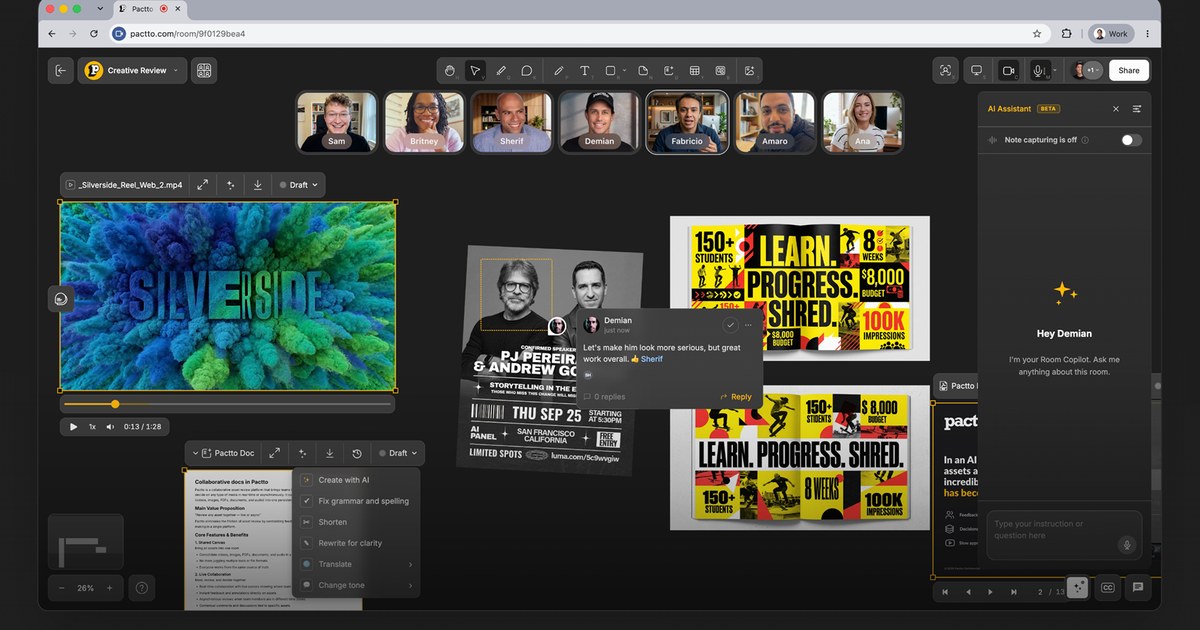
Pactto is an AI-native platform for creative teams to present their work at studio quality, review assets with the assistance of AI agents that understand creative intent and capture every note, and then turn that feedback into changes, live. Each Pactto room is a persistent workspace for a project, campaign, client, or team where assets, people, discussions, decisions, and AI context live together. It is built so that a whole team sees the same work, hears the same conversation, and makes decisions together inside one shared context instead of scattering them across separate tools.
The problem Pactto sets out to solve is described plainly on the site: with AI, assets are created faster than ever, but the review process has not caught up. Feedback is scattered everywhere, decisions get lost after sessions, approval cycles take forever, and versioning has reached insanity, so humans and traditional review processes become the bottleneck. Video calls and async review tools each only cover part of the job. Unlike Zoom or Google Meet, where context disappears when the call ends, Pactto rooms remember everything — every conversation, every decision, every piece of feedback — so context does not disappear, it compounds.
At the center of the product are persistent creative rooms. Each room is a smart canvas that supports videos, images, PDFs, SVGs, audio, and multi-screen sharing, and it is assisted by an AI agent that is always available with full context. Rooms persist for every project so teams can meet, collaborate, present work at the same time, and access the room memory at any time. Because the canvas holds every asset, board, and decision, work is reviewed at full quality rather than through a compressed screen share, and multiple people can share screens simultaneously — for example an editor in Premiere on one side and a designer in Figma on the other, with the director watching and guiding both.
Live Editing is the feature the company describes as unique: say it and watch it change, right in front of everyone. The AI assistant is always listening, building context, suggesting actions, and taking action. A director can say that the pacing feels slow or that the color on the hero shot is too cool; the assistant captures that as a structured comment with full context and then suggests a warmer grade that can be applied in one click so the image updates on the canvas while everyone watches. The same assistant can generate three alternative hero shots, create a doc with all the action items from a session, or execute commands such as creating a doc with all tasks for a specific person, or moving all images to the right and all sticky notes to the left. Teams can add their own rules and customize the assistant's behavior per room to match their workflow.
Review tools extend well beyond text. Users can draw directly on any frame with lines, shapes, text, or freehand, pin comments to specific frames or frame ranges, and even speak comments instead of typing them. The assistant sees those annotations and builds on them, turning feedback into edits, summaries, and tasks in the browser. Statuses can be tracked visually on a board or via agents, docs update live, and approvals get tracked. Room memory is what makes the context compound: come back next week for a follow-up review and the AI already knows what was discussed, what was decided, and what still needs attention — in the company's words, the room is the notes. Real-time translation removes language barriers: the assistant transcribes the conversation in real time, separated by speaker and timestamp, and translates it live into each participant's language, supporting English, Português, Español, French, 中文, 日本語, 한국어, Deutsch, Bahasa Indonesia, Italiano, and العربية.
Pactto organizes its approach around three things every creative team does — present, review, and approve — and accelerates all of them in one place. For presenting, video plays at studio quality for everyone at the same time without lag, color-accurate and frame-accurate, with no compression artifacts and no dropped frames. For reviewing, voice comments go in and agents act live, capture and act happen in the same room and the same breath, and everyone watches the same frame through synced playback. For approving, decisions happen inside the room, docs update live, approvals are tracked, and rooms persist so every decision, asset, and version stays exactly where it was left. Assets arrive from local drag and drop, from Adobe Frame.io through a partnership with Adobe, from Google Drive, and via Google Sign In, with Dropbox and Air listed as coming soon.
The stated outcome for teams is faster delivery: the company cites teams delivering work in days instead of weeks and moving from v1 to vFinal faster than ever. Approvals happen before the conversation ends rather than after a cycle of uploading v3, waiting for notes, uploading v4, and starting over. Because the room keeps every decision and the AI keeps every note, nobody has to pull up notes from last time, and no nuance is lost while someone scrambles to write feedback down. Every stakeholder gets notified, every status gets updated, and everything moves forward. Testimonials on the site describe Pactto as a candidate to become the operating system of the new creative process, and as a new interface for creative teams producing work using AI.
Pactto lists a wide range of use cases, each framed as one room used a different way. Creative agencies can run their most complex AI projects in one room, managing every asset, board, and decision and tracking images, video, and PDFs from v1 to launch. Podcast teams can give every episode its own room, brief it, review the cut at real quality, generate cover art, and map every social short in every format. Roundtables can host recurring group sessions in a persistent room where the AI keeps summaries and action items and new members catch up on full history. Language tutors can keep one room per student, share materials, mark up pronunciation and grammar, and let the AI keep every correction and vocabulary list. Sports and mental coaching use frame-accurate video review, live annotation of form, and a room per athlete where training logs and commitments build week over week. Architects present renders, plans, and PDFs at full resolution and get sign-off live. Founders can pitch investors in a room that captures every question and follow up in the room rather than with an attachment. Event organizers can track roles, sponsor commitments, and the run of show in live tables and boards.
Pactto is aimed at distributed creative teams and the people around them: directors, editors, designers, producers, agencies, podcast teams, coaches, tutors, architects, founders, and event organizers, along with the clients and reviewers who need to participate. Reviewers and clients do not have to pay on Pro — unlimited guests can be invited to a room with a link without an account or a paid seat. On the free plan there is no guest link, so people join by direct invite only. The free plan costs $0 with no card required and includes two active rooms, all editing and commenting tools, 5GB of storage, five members with room access, 60-minute meetings, 10 one-time AI credits, 60 minutes of live translation, and room memory that remembers the most recent session. Pro costs $19 per month billed annually ($228 a year) or $25 billed monthly and adds unlimited rooms and guests, 500GB of storage, persistent room memory, unlimited meeting summaries and guest sessions, 100 AI credits monthly, eight hours of live translation, integrations with Frame.io, Google Drive and Air, and CLI access that lets teams point Claude Code or Codex at a room to read or write its contents from the terminal. Security features include end-to-end encryption, SOC 2 in progress, and encryption on AWS S3 buckets, and fully white-labeled deployments are offered for agencies and enterprises that want to present Pactto under their own brand.
Pactto's primary promise is a single persistent room where creative teams present at the quality their work deserves, review with an AI agent that understands creative intent and captures every note, act on feedback live, and approve before the conversation ends — with context that compounds instead of disappearing.
Publisher
A
admin
Launch Date2026-09-24
Platformweb
Pricingfreemium
Tech Stack
#AWS S3