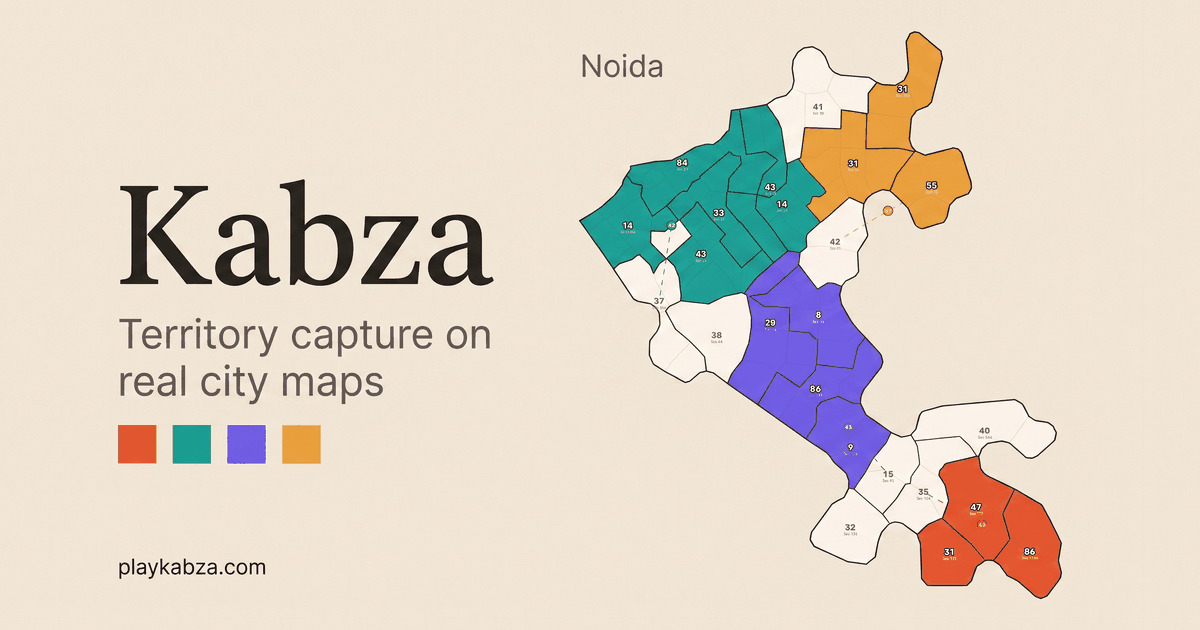
Kabza is a real-time territory capture game played on the real maps of Noida, Gurugram, Delhi and Bengaluru. Rather than an invented fantasy world, it drops you onto city maps divided into wards, where rival fictional parties already hold ground and Independents sit in the middle of the fight. Your job is simple to describe and hard to master: drag from a ward you hold to any other ward to send half its supporters, take territory, and outgrow the rival parties until you control 75% of the map. It is made for people who want a competitive strategy match without setup friction. You can play solo against bots, or open a room of up to eight and battle friends. It runs free in your browser, with no download and no account needed.
Most browser strategy games ask you to care about places that do not exist. Kabza's premise is that the map itself is the hook. The territory you are fighting over is recognisable: Noida, Gurugram, Delhi or Bengaluru, laid out as a real map divided into wards and coloured by the parties that hold them. That familiarity makes the game easier to read at a glance and more interesting to argue about afterwards, because the board looks like somewhere you have actually been. Two other frictions are removed at the same time. There is nothing to install and there is no sign-up: the product is described plainly as free in your browser, with no download or account needed. That combination of familiar geography and near-zero setup means a match can begin in moments, whether you are playing alone or bringing a group of friends into a room.
The central mechanic in Kabza is drag-and-send. The on-map instruction reads: drag from a ward you hold to any ward to send half its supporters. Every action you take is therefore a trade-off. Sending supporters outward takes half of what a ward currently holds, which means a strong ward becomes weaker the moment it attacks, and a ward you strip too aggressively becomes an easy target for a rival party. Because the cost is always half, the maths scales with your own strength: large holdings can project serious force, but they also bleed proportionally whenever they move. This single rule gives the game its strategic texture. You are constantly deciding whether to press an advantage right now or hold supporters back to defend what you already own, and that decision repeats for every ward on the board.
The map is divided into wards, and the interface keeps the state of the match in front of you. Kabza surfaces three things directly: Party, Wards and Supporters, alongside a count for Independents, the unaligned holders shown in the interface. Wards are the units of territory; supporters are the resource that flows between them; parties are the competing colours on the map. The published artwork for the game shows exactly this: a map of Noida's sectors coloured by rival fictional parties. Because everything is expressed in those three terms, there is very little to learn before you can read the board. You look at who holds what, how many supporters are stacked where, and which direction a push would leave you exposed.
Kabza supports two ways to play. In solo mode you face bots, which lets you learn the drag-and-send rhythm and the 75% win condition without the pressure of other people. In multiplayer you join a room with up to eight players, so a single match can involve a full table of friends fighting over the same real city map. The game is described as real-time territory capture, meaning everyone is acting on the same live board rather than taking turns, and the interface displays a timer that runs during the match. That changes how you think about your moves. A decision you hesitate over is a decision someone else may already be making, and the map can shift while you are still working out where to send your next wave of supporters.
Put together, the loop is straightforward. You begin on a real city map divided into wards, with rival fictional parties and Independents holding ground alongside you. You build supporters in the wards you control and then drag between wards to move them. Each send transfers half of a ward's supporters to the target, so attacking is always funded out of your existing position. Taking wards shifts the balance of the map; losing them shifts it back. The interface shows a growth state described as 'growth doubled until a ward changes hands', which tells you that supporter growth is affected by changes in ward ownership. The match ends when one side holds 75% of the map — a threshold high enough that you have to keep expanding, and high enough that a comeback remains possible while the board is still contested.
The first benefit is access. Kabza is free in your browser, with no download and no account needed, so trying it costs nothing but time. The second is readability. Because the game is played on real maps of Noida, Gurugram, Delhi and Bengaluru and expressed through three simple concepts — party, wards and supporters — new players can understand the board almost immediately, while the half-of-your-supporters rule keeps every decision non-trivial. The third is flexibility: play solo against bots if you want a quiet match, or open a room of up to eight when you want company. And because matches are decided by a clear threshold of 75% of the map, every session has a definite target to push toward rather than an open-ended slog.
There are several clear ways people use Kabza. A group of friends who all know a city can open a room of up to eight and settle an argument about which parts of the map matter, fighting over wards they recognise. Someone new to the game can play solo against bots to get comfortable with dragging supporters and reading the party, ward and supporter counters before joining other people. A quick browser match suits a short break, because there is nothing to install and no account to create — you open the page and play. And because the maps cover Noida, Gurugram, Delhi and Bengaluru, players from those cities can play on home ground, with a board that looks like somewhere they have actually been.
Kabza is aimed at people who enjoy short, competitive strategy games and want to start one without friction, particularly those who know Noida, Gurugram, Delhi or Bengaluru and enjoy seeing a familiar city turned into a contest. It is listed under Indie Games, Strategy Games and Free Games, which fits its identity as a free, browser-based title. The product is delivered on the web: the game itself is described as free in your browser, so there is no store, installer or sign-up step standing between a player and a match. Pricing is free, and no account is required to start playing.
Kabza's value proposition is narrow and clear. Take a real city map, divide it into wards, give each player a pile of supporters and one beautifully simple rule — dragging from a ward you hold sends half its supporters to another ward — then let rivals fight over the board until someone holds 75%. Wrap that in a browser game that is free, needs no download and no account, and supports both solo play against bots and rooms of up to eight friends, and you have a strategy game that is quick to start and immediately understandable. The real maps of Noida, Gurugram, Delhi and Bengaluru are what make it memorable.
Publisher
A
admin
Launch Date2026-09-13
Platformweb
Pricingfree