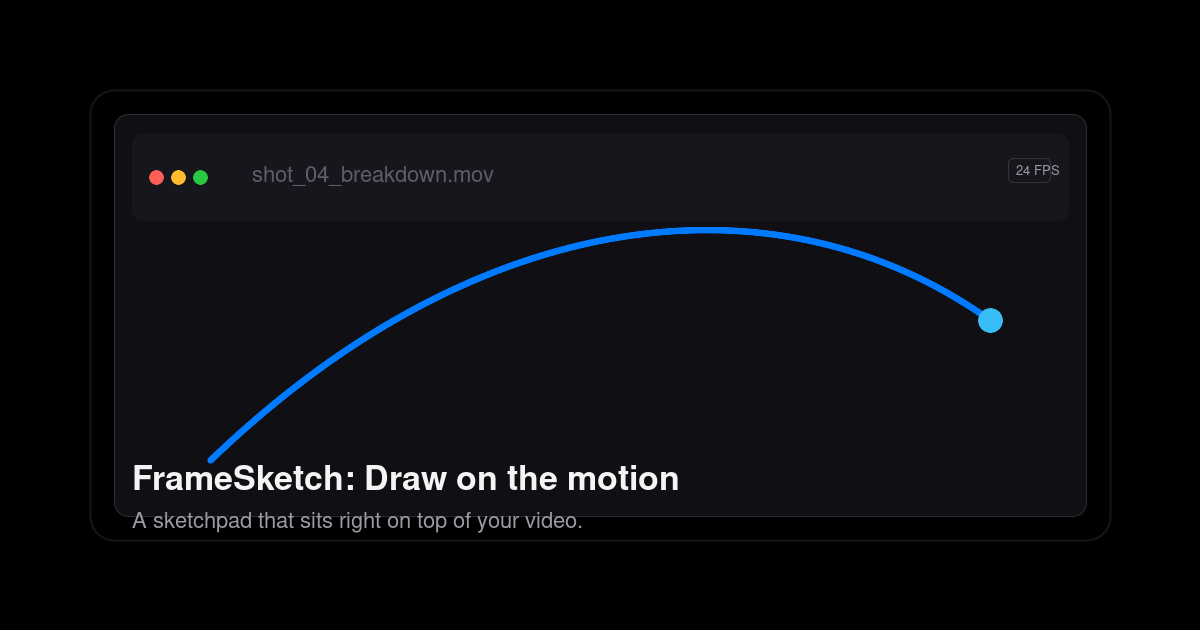
FrameSketch is a video annotation tool that lets animators sketch directly on top of their footage. You drop in a video, step through it frame by frame, and draw right on the canvas — arcs, breakdowns, poses, sticky notes — with every line fixed exactly where you left it. It is built for animators, VFX artists, and motion designers who need to mark up motion rather than describe it in words or rebuild stills in another application. FrameSketch runs in the browser and as a PWA, is free to use, and keeps your footage on your own device.
Annotation is the whole point, and FrameSketch keeps that workflow short. Rather than opening a full animation suite, juggling plugins, or working through export settings, you open a file, draw, and get back to the shot. The site positions it as the opposite of animation-suite bloat: no plugins, no export roulette, and no timeline lag, and no project-browser rabbit holes when you want to get back into work in progress. Review is part of the problem it solves too — the tools you reach for mid-review are built in, so a shot review does not turn into a detour through several other applications. And because footage can be private or simply huge, FrameSketch never uploads it: local-first by default, with optional cloud sync that only ever carries annotations.
The core of FrameSketch is frame-accurate annotation. You can walk footage frame by frame, scrub to a section, and see the frame number as you step through it. Lines land on the exact frame you drew them on, so the canvas never drifts away from the video beneath it, and stepping forward or back keeps each drawing locked to its frame. The frame-by-frame timeline lets you mark a stretch of footage and play just that range on a loop, which is useful for studying a cycle or a specific beat repeatedly. Onion skin completes the picture: you can peek at the frames before and after the current one and tune the ghosting until it feels right, which supports exactly the kind of spacing and breakdown judgement animators make when checking arcs.
Drawing itself is designed to feel immediate. FrameSketch is pressure sensitive, so pen input translates into the stroke, and the editor offers four pens drawn from one palette. Strokes stay put: each line is fixed the moment you lift the pen, so your marks remain exactly as drawn, frame after frame, instead of shifting under the video. Annotations live on real layers — you can stack strokes, shapes, and notes, reorder them, hide them, and dial in each layer's opacity independently. That makes it possible to keep a rough pass separate from a corrected pass, or keep notes distinct from drawing, without flattening everything into a single image.
FrameSketch also bundles the collaboration and alignment tools a shot review needs. Sticky notes and comment markers can be pinned right on the frame, then moved, resized, recolored, and edited at any time — so feedback sits on the exact moment it refers to instead of in a separate document. Grids, rulers, and guides help you line marks up by eye: grids can be rectangular or isometric and drawn as dots or lines, and you can drag guides out of the rulers to align your marks where you need them. Pan and zoom let you move into the detail of a shot and back out again while your annotations stay exactly where you left them. Scenes and backgrounds round this out: one project can hold many scenes, and every scene sits on a solid background layer, so you can hide or dim the video whenever you want to look at your lines on their own.
FrameSketch works in three steps. First you drop in a video — any local file, read straight from your machine, with nothing leaving it and nothing re-encoded. The file picker lists what your platform can really play: MP4 with H.264, which is recommended and plays everywhere; MOV, a QuickTime container whose H.264 content plays everywhere; M4V, the same H.264 core as MP4; and WebM, the open VP8/VP9 codec that plays on Windows, Linux, and Chromium (on macOS, the site suggests using MP4 or MOV instead). Anything else can be converted once to H.264 MP4 and will then play anywhere. Second, you draw on the frames, with each line fixed the moment you lift the pen. Third, you share the project: a single small .fsk file holds every stroke, so you can email it, open it, and keep going. FrameSketch runs entirely on your machine, and cloud sync is optional — it only carries annotations, never footage.
The result is a review loop that stays quick and private. Because each line is fixed to its frame and the canvas never drifts, you can trust what you see when you come back to a shot later. Because a whole project is only a few hundred kilobytes, projects are small enough to email, stash, or version rather than shipping heavy media around. Because your footage stays on your machine, you can annotate client material or unreleased shots without uploading them anywhere. And because cloud sync only carries annotations, you can let annotations follow you across devices — or turn the cloud off entirely and keep everything local.
Concretely, animators use FrameSketch to mark up arcs and poses over reference footage: drawing the line of action, blocking breakdowns, and checking the spacing between keys with onion skin. VFX artists and motion designers can annotate a shot frame by frame, pinning notes and comment markers to the exact frames a review refers to, then loop a marked range to study the motion repeatedly. For shot review, sticky notes and comment markers on real layers keep feedback in the same place as the drawing, and the .fsk file makes it possible to hand the annotated project to someone else and let them continue from the same strokes. Alignment-heavy work benefits from the rectangular or isometric grids and guides dragged out of the rulers, and anyone working with confidential or unreleased footage can annotate locally without ever uploading the video.
FrameSketch is aimed squarely at animators, and the site also names VFX artists and motion designers — the people who think frame by frame and reach for a pen mid-review. It is free to use, and the site says your first arc takes about ten seconds. It works in the browser and as a PWA via app.framesketch.xyz, and desktop apps for Windows and Linux are stated as coming soon. Cloud sync is an optional toggle that carries annotations only.
FrameSketch's promise is simple: the motion is right there, so draw on it. It replaces describing a pose or compiling screenshots with direct annotation on the footage — frame-accurate, pressure sensitive, layered, and local-first. Free to use, with tiny .fsk project files that travel easily and footage that never leaves your device, it gives animators a fast, private way to mark up motion and pass the notes along.
Publisher
A
admin
Launch Date2026-09-13
Platformweb
Pricingfree
Tech Stack
#PWA