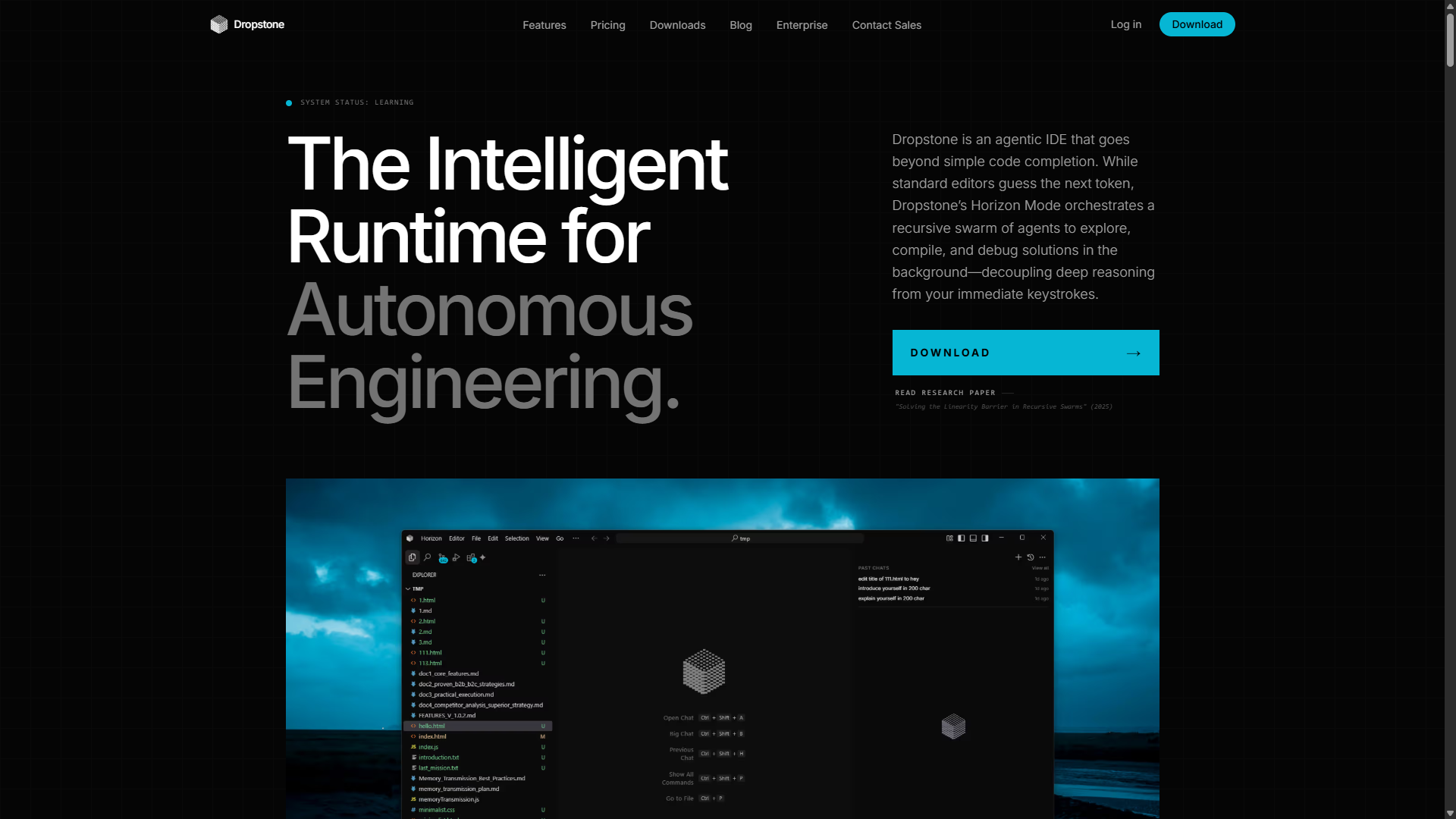
Dropstone is an autonomous software engineering runtime designed to fundamentally transform how developers build software by replacing traditional integrated development environments with a system powered by self-correcting intelligence. This platform is engineered for professional developers and engineering teams who seek to dramatically increase their productivity and code quality while reducing manual effort and cognitive load. Its primary purpose is to serve as a comprehensive coding environment that autonomously handles complex software engineering tasks, leveraging advanced artificial intelligence to reason about code, understand context, and execute refactoring operations at a scale suitable for enterprise applications. The system operates continuously in the background, analyzing codebases, suggesting improvements, and implementing changes with a high degree of accuracy and reliability, thereby allowing human engineers to focus on higher-level design and strategic problem-solving.
Traditional software development is plagued by significant inefficiencies and pain points that hinder productivity and innovation, including the constant context switching between different tools, the manual and error-prone nature of code refactoring, and the cognitive overhead required to maintain large, complex codebases over time. Developers often spend excessive amounts of time on repetitive tasks such as debugging, writing boilerplate code, and ensuring consistency across projects, which detracts from their ability to work on creative and impactful features. Furthermore, the limitations of conventional IDEs, which are largely passive tools requiring explicit human input for every action, create bottlenecks that slow down development cycles and increase the likelihood of introducing bugs and technical debt into the system.
The Horizon Mode architecture represents the first major feature group, providing a foundational framework that enables the runtime to operate with infinite context and maintain a persistent, evolving understanding of the entire codebase and development environment. This architecture allows Dropstone to process and reason about vast amounts of code, documentation, and project history without being constrained by typical memory or context window limitations seen in other AI-assisted tools. By maintaining a holistic view, the system can make more informed decisions, understand deep dependencies, and execute complex refactoring operations that span multiple files and modules, ensuring consistency and correctness across the entire project. This capability is critical for enterprise-scale applications where codebases can comprise millions of lines of code and involve intricate interdependencies that are difficult for humans to fully grasp and manage manually.
admin
The D3 Engine constitutes the second major feature group, driving the agentic reasoning and autonomous refactoring capabilities that distinguish Dropstone from simpler code generation tools. This engine empowers the runtime to act as an autonomous agent that can plan, execute, and verify complex software engineering tasks with minimal human intervention. It goes beyond merely suggesting code snippets by actively understanding the intent behind changes, evaluating multiple potential solutions, and implementing the most optimal one while ensuring that all tests pass and existing functionality is preserved. The engine's self-correcting intelligence allows it to learn from feedback, adapt to project-specific conventions, and improve its performance over time, making it an increasingly valuable partner in the development process rather than just a static tool.
Additional capabilities include advanced contextual understanding, memory across conversations, and the ability to connect any tool through Remote MCP, which significantly enhances the system's utility and integration into existing workflows. The platform supports web search inside the agent, allowing it to pull in relevant information, documentation, and examples from the internet to inform its coding decisions and problem-solving approaches. Context summarization with precision engineering enables the system to distill complex information into actionable insights, while larger working context windows and higher file upload limits accommodate the demands of large-scale projects. Saved agent presets and system prompts allow teams to customize and standardize the behavior of Dropstone across different projects and use cases, ensuring consistency and alignment with organizational standards and best practices.
Overall, Dropstone works by integrating deeply into the developer's environment through its CLI and dashboard interfaces, running continuously to monitor code changes, understand developer intent, and proactively suggest or implement improvements. The technical approach combines state-of-the-art AI models, including the Dropstone Fast, Pro, and Heavy tiers with XHigh Thinking, with a specialized runtime architecture optimized for software engineering tasks. It processes code not just as text but as structured data with semantics, dependencies, and historical context, enabling it to perform reasoning that mirrors human software engineering thought processes. The system operates in a collaborative manner, where developers can issue commands, review suggestions, and provide feedback, creating a synergistic workflow that amplifies human capabilities rather than replacing them entirely.
Benefits and measurable outcomes for users include substantial increases in development speed, significant reductions in bug rates and technical debt, and improved code quality and consistency across projects. Developers can ship features faster because Dropstone handles many of the time-consuming, repetitive tasks involved in coding, testing, and refactoring, freeing up engineers to concentrate on innovation and complex problem-solving. Teams experience fewer production incidents and easier maintenance due to the system's ability to enforce best practices, identify potential issues early, and ensure that code remains clean, well-documented, and aligned with architectural guidelines. The autonomous nature of the runtime also reduces cognitive load and fatigue among developers, leading to higher job satisfaction and better retention of engineering talent within organizations.
Concrete use cases with specific workflow examples include automating large-scale refactoring operations, such as migrating a codebase from one framework version to another or converting a monolithic application into microservices, where Dropstone can plan and execute the changes across thousands of files while maintaining functionality. Another example is in onboarding new developers, where the system can quickly familiarize them with the codebase, explain complex modules, and generate examples of common patterns used in the project. During feature development, Dropstone can assist by generating boilerplate code, writing unit tests, and suggesting optimizations, allowing the developer to focus on the unique business logic. For legacy system maintenance, the runtime can analyze outdated code, identify security vulnerabilities or performance bottlenecks, and propose modern, efficient replacements that integrate seamlessly with the existing architecture.
Target users primarily include professional software developers, engineering teams, and enterprises that manage large, complex codebases and seek to optimize their development processes. Integrations are facilitated through the Remote MCP, allowing connection to any external tool or service, and the platform offers a CLI and dashboard for interaction. The tech stack leverages advanced AI models and a proprietary runtime architecture, with pricing plans structured to accommodate different needs: a Free tier with limited usage, a Pro tier at $12.50 per month billed annually offering more usage and advanced capabilities, and a Max tier at $75 per month billed annually providing the highest usage limits, priority routing, and early access to features. Each plan includes access to specific model tiers and capabilities, with the Pro and Max tiers also granting access to Blankline Research and the latest engineering research upgrades.
In summary, Dropstone represents a paradigm shift in software development tools by introducing an autonomous, intelligent runtime that actively participates in the coding process, handling complex tasks with precision and scale. Its primary value lies in augmenting human developers, enabling them to build more with less effort, reduce errors, and maintain high-quality codebases over time. By combining infinite context, agentic reasoning, and self-correcting intelligence, the platform addresses fundamental inefficiencies in traditional development workflows, offering a tangible path to faster innovation, reduced costs, and more sustainable engineering practices for teams of all sizes.
Dropstone targets professional software developers, engineering teams, and enterprises that manage large, complex codebases and seek to optimize their development processes. It is designed for those who want to increase productivity, reduce manual coding effort, and maintain high-quality software through autonomous intelligence. The platform caters to users needing advanced contextual understanding, agentic reasoning, and scalable refactoring capabilities, from individual developers using the Free tier to large teams requiring the Max tier's high usage limits and priority features.
Updated 2026-02-28